LED screen video: specifications and technical delivery
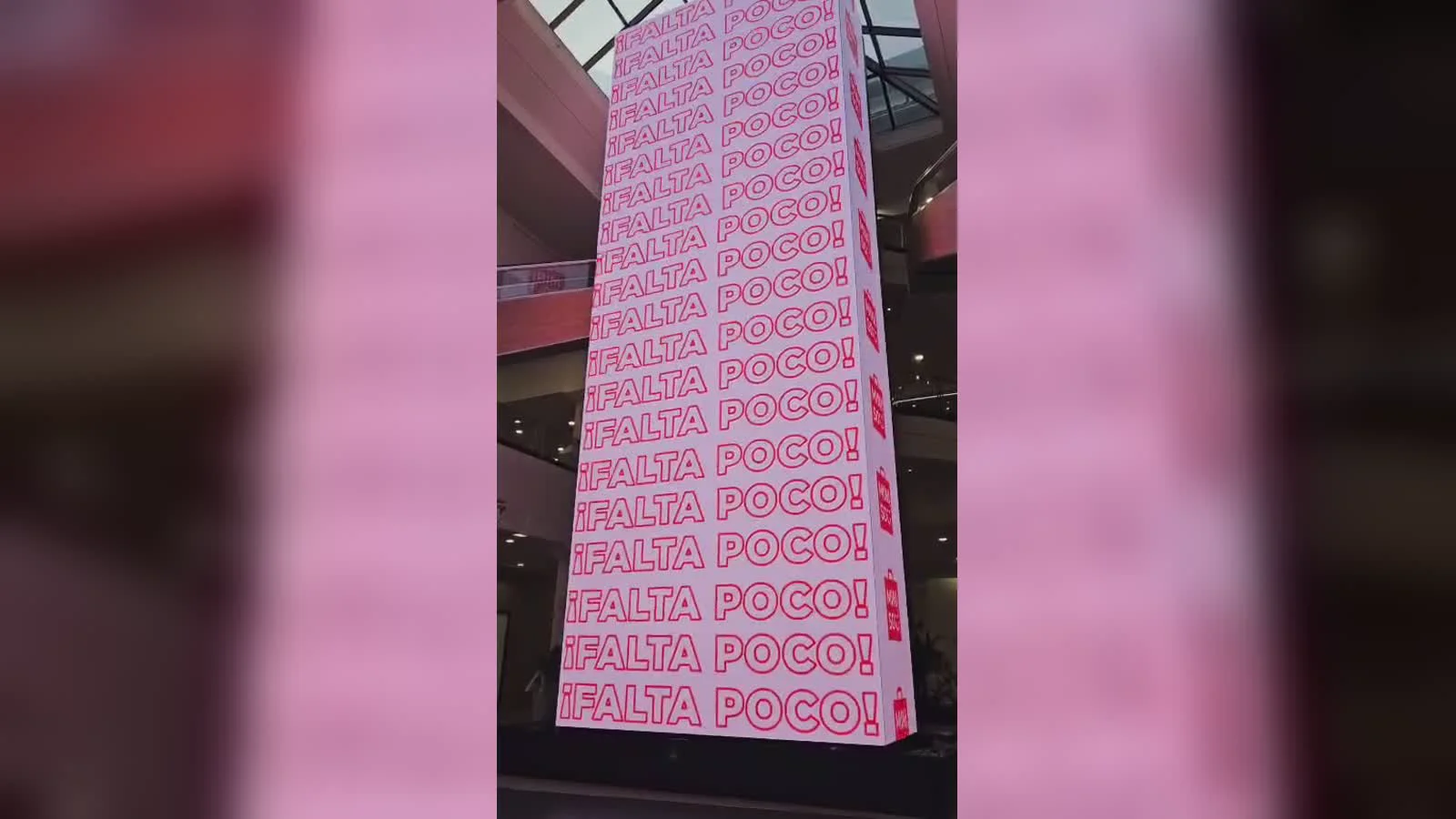
A video for an LED screen is produced at the module's real pixel resolution, not at a generic proportion, and it is delivered with the length, format and loop the circuit operator asks for. Before designing, it is worth asking for those specifications in writing and, at the end, mastering the piece for the screen's brightness.
Who sets the specifications of an LED screen
They are set by whoever operates the screen: the shopping center, the outdoor advertising company or the equipment provider. Each screen is different, and what worked on one is no rule for the next. That is why the first step of a piece for LED, before any idea, is an email to the operator asking for the technical sheet.
These are the questions worth asking before designing:
Exact resolution in pixels, width by height.
Whether the screen takes a single file or several, by face or section.
File format, container and codec the player accepts, and frames per second.
Length of the spot and total length of the loop.
Whether it has sound.
Maximum file size, deadline and delivery channel.
Whether a test can be run on the screen before going live.
With those answers in writing, the piece is designed once. Without them, it gets redone at the end.
Why resolution is measured in real pixels and not in proportion
An LED screen is built from modules, and its resolution is the real number of light points across its width and height. It depends on the size of the screen and the distance between those points. Two screens of the same size can have very different resolutions.
That is why saying "it's vertical" or "it's 16:9" is not enough. Many shopping center screens do not follow any standard proportion. MINISO's screen at Unicenter, with a teaser and opening campaign, was extremely vertical. A video produced at a generic proportion and stretched afterwards loses sharpness, gets distorted or shows black bars.
Resolution also shapes the design. With few pixels, a thin typeface or a fine line breaks up. Text size is planned in real pixels and in the distance it will be viewed from, as explained in the article on motion graphics for screens.
What changes in brightness, color and contrast on an LED screen
An LED screen emits light much more intensely than a monitor. Saturated colors become more saturated, dark gradients can show banding and a pure white background can be dazzling. What looks good on the studio computer is no test of how it will look in the shopping center.
The screen also competes with its surroundings: daylight, shop windows, other screens. And it almost always works without sound, as was the case at Unicenter. Everything the piece has to say has to be understood by looking.
Length, loop and scheduling within the circuit
In most circuits the piece shares the screen with other content, in a rotation with fixed lengths. The operator says how many seconds the spot has and how often it comes back. That length rules over the script: if the idea needs more time, the idea is adjusted.
It is also worth thinking about what someone who arrives halfway through the piece sees. In a shopping center people pass by, they do not sit down to watch. On Alto Palermo's LED screen for the World Cup the audience was on the move and watching from different distances, so the scale of the characters, the hierarchy of the texts and the visual path were designed for that screen and not for a phone screen.
If the campaign changes phase, as at Unicenter, where the screen went from announcing MINISO's arrival to saying it had opened, each phase is a new delivery: it is worth agreeing both upload dates with the operator from the start.
What mastering a video for LED means
Mastering is the last technical pass before delivery. Levels, color and contrast are adjusted for that screen's brightness, the fine details the resolution can break are reviewed and the file is exported exactly at the pixels, format and length the operator asked for. If there is more than one screen, there is one file per screen, built for its format and not cropped from another.
Whenever possible, the final test is done on the real screen. It is the only way to see what the audience will see. Mastering for LED is part of the retail, screens and DOOH service.
If you are starting out with this format, the article on content for LED screens explains what kind of pieces work, the one on DOOH and screens explains the medium, and the case of MINISO at Alto Palermo with six screens shows how a single campaign is adapted to several formats.
Frequently asked questions
What resolution should a video for an LED screen have?
The exact pixel resolution of that screen, width by height, provided by the operator. There is no standard size: it depends on the size of the screen and the distance between its light points, and two screens of the same size can have different resolutions. Producing at a generic proportion and stretching afterwards makes the piece lose sharpness or get distorted.
In what file format is it delivered?
In the one the screen's player accepts, which the operator also provides: file format, container, codec, frames per second and maximum size. It changes depending on the equipment and the circuit, so it is worth asking for it in writing before starting the design. If there are several screens, one file is delivered for each, built for its format.
What should I ask the screen operator?
Exact resolution in pixels, whether it takes one file or several, format and codec, frames per second, length of the spot and the loop, whether it has sound, maximum file size, deadline and delivery channel, and whether a test can be run on the screen before going live. With those answers the piece is designed once and not redone at the end.
Why does a video look different on the screen than on the computer?
Because an LED screen emits light much more intensely than a monitor and has a different pixel density. Saturated colors become more saturated, dark gradients can show banding and fine details get lost. That is why the piece is mastered for that screen's brightness and, whenever possible, tested on the real screen before going live.
How a piece mastered for a very vertical screen looks can be seen in MINISO's campaign at Unicenter.


