Content for LED screens: designing video for the space

Content for LED screens is video designed for the physical format where it will be seen. It takes into account the screen's format, which is usually vertical or very wide, the distance and the time a passer-by has to look at it, and the fact that it is almost always seen without sound. A piece designed this way is understood in a few seconds.
What follows is useful for a brand buying media on third-party screens, for a shopping center with its own screens and for an agency that has to deliver for that format, with three published cases as examples.
Why an LED screen is designed for people passing by
An LED screen is in a place: a hall, a column, a store facade, a bridge over a walkway. Nobody sits down to watch it. People walk past, see it from a distance, from another floor or from the side, and give it a few seconds.
That changes the starting point. On social media, a video competes with other videos on the phone. On an LED screen it competes with the whole space: shop windows, signage, people, light. The piece has to work in that context, and that is why it is designed for the format from the idea onward.
We saw it on the World Cup LED screen at Alto Palermo: a very tall vertical screen, seen by people on the move and from different distances. Resizing a social media piece was not going to work, so the scale of the characters, the hierarchy of the texts and the visual path were designed for that screen. Why a format like that calls for more than a banner is in DOOH and screens.
Format and proportion: vertical, wide and extreme
LED screens in shopping centers and stores rarely have the proportion of a television. There are very vertical columns and totems, very horizontal bridges and fronts, and formats that follow the architecture of the place. The proportion defines where the subject can be, how much text fits and how the image is read.
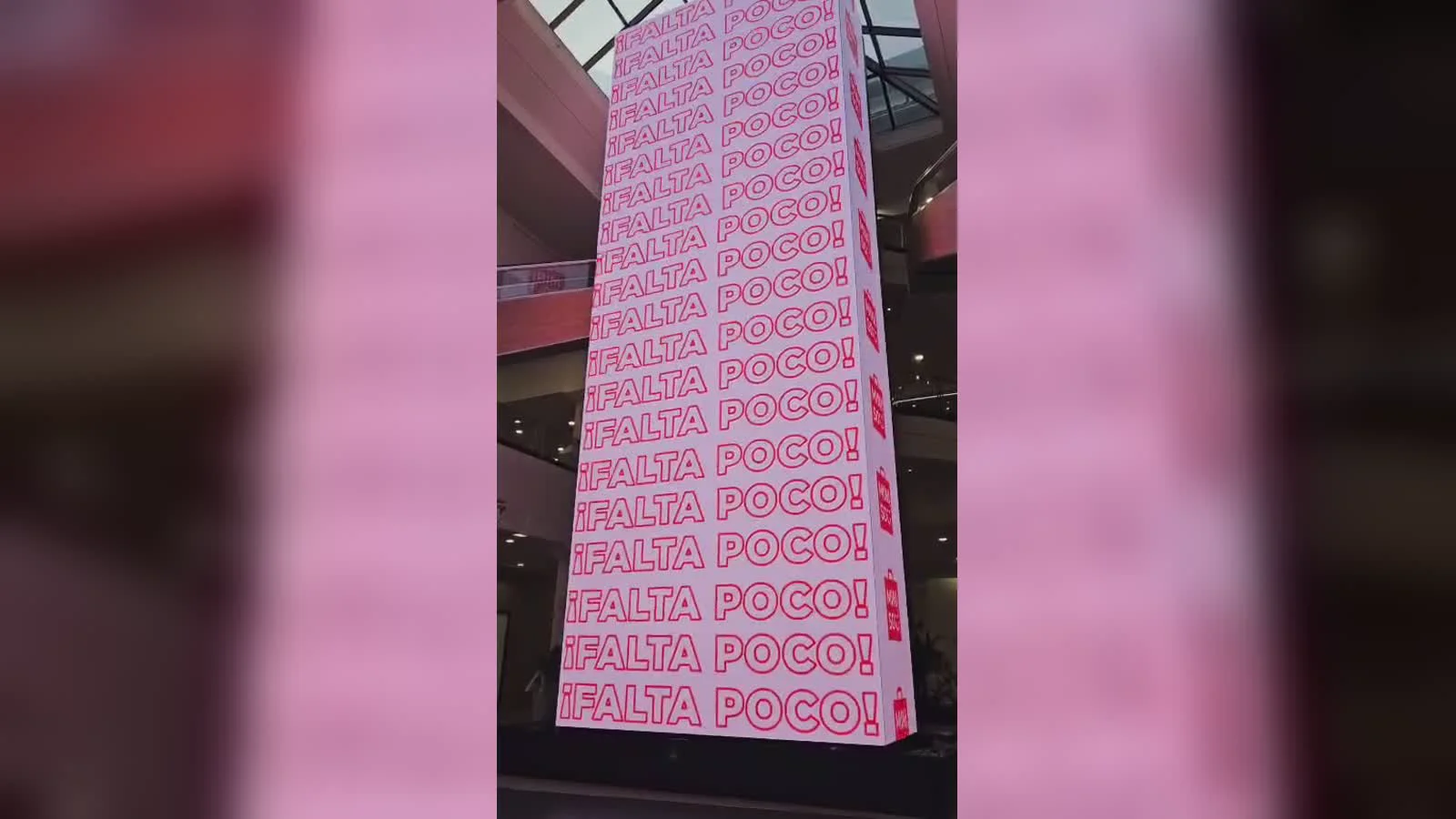
For MINISO's arrival at Unicenter, the screen was extremely vertical, worked without sound and was seen from different levels. The campaign had two phases, teaser and opening, with the same visual universe. Because everything was designed for that format from the start, going from "Coming soon" to "Now open" did not mean redoing the campaign.
When a campaign has to live in several formats, each one is redesigned. The MINISO campaign at Alto Palermo took a single idea to six formats: LED bridges, columns, totems and outdoor screens. The process is told in the article on MINISO's six screens at Alto Palermo, and the general criteria in how to adapt a campaign to many screens.
Viewing distance and reading time on an LED screen
Someone looking at an LED screen in a shopping center sees it from several meters away, sometimes from another floor, and almost always while moving. The piece is designed for that time and that distance.
One message per piece. If two ideas have to be read, the second one does not get through.
Short, large text. Few words, a typeface with weight and good contrast with the background.
Brand visible from the start. Someone who looks for a few seconds has to know whose piece it is.
A composition that can be understood from afar. Large subjects, few elements, figure and background clearly separated.
A simple test: look at the piece small, from a distance, for three seconds. If in that time it is not clear what it says and whose it is, it will not be clear on the screen either.
How to tell a story without sound
LED screens in commercial spaces usually work without sound. Everything a voice or music would handle on social media has to be handled by the image.
There, movement does the narrative work. A clear change, a character who appears, an object that arrives: movement guides the eye and orders the reading. The opposite also holds. Not everything has to move, and a piece loaded with effects reads worse than one with a single well-chosen gesture. Motion graphics for these formats have their own rules, which are in motion graphics for screens.
Loop, scheduling and sharing the screen with other ads
A piece for an LED screen is almost never seen from beginning to end. It repeats in a loop and shares the schedule with other ads, so each person starts watching it at a different point.
The loop has to close. The last frame joins the first one without an abrupt jump.
The brand stays throughout the piece. If it only appears at the end, someone who arrived halfway leaves without knowing whose it was.
The length is set by the slot. The operator assigns a length in its schedule, and the piece is written for that length.
Contrast with what comes before and after. A piece that stands out from its neighbors is remembered.
Where LED screens appear and what each one calls for
The screens in a shopping center's hall or on its columns are a medium with its own audience, and it is worth planning them as part of the shopping center's calendar. This is laid out in the guide to video for shopping centers. Screens at the point of sale, inside a store or in its window, follow another logic: they are a few meters from the product and accompany a purchase decision, as explained in screens at the point of sale.
There are also screens at conferences, events and corporate spaces, where the piece is usually institutional. What the article on corporate video with AI covers applies there. And many agencies have to deliver pieces for these formats without an in-house team to produce them; for that case there is the article on agencies and production.
In every case, AI production expands what can be shown on the screen: settings, characters, scales. What organizes the result is still the design for the format. How AI fits into the whole process is in AI video production.
What is checked before delivering a piece for an LED screen
Before delivery, the piece is reviewed with the real screen in mind, not an editing monitor.
The operator's specifications. Resolution in pixels, proportion, length, file format, file size and frames per second. They are requested in writing before production.
Mastering. Brightness, contrast and color adjusted to how an LED screen emits light, which behaves differently from a monitor.
Legibility on site. If possible, a test on the screen or a scale simulation, seen from where people will see it.
The full loop. That it joins up well and that the brand is present throughout the piece.
Which specifications to ask for and how to read them is in video specifications for LED screens. This type of piece is part of the retail, screens and DOOH service.
Frequently asked questions
What resolution does a video for an LED screen need?
The one that screen has in pixels, which almost never matches standard video formats. Each LED screen has its own resolution and proportion, and they are set by the operator or the owner of the format. The right approach is to ask for those specifications in writing before production and to design the piece to that size, instead of adapting a file made for another screen.
How long should a piece for an LED screen be?
The length is set by the slot the operator assigns in its schedule, and it is worth asking for it before writing the piece. Within that length, the main message and the brand have to be understood in the first seconds, because most people only see a fragment as they pass. The piece repeats in a loop, so the ending has to join the beginning.
Can the same social media video be used on an LED screen?
You can start from the same idea, but the video almost always has to be redesigned. The screen has a different proportion, and it is seen from afar, without sound and for a few seconds. On the World Cup LED screen at Alto Palermo, resizing a social media piece was not going to work, and the piece was designed from scratch for that format.
Does a piece for an LED screen need sound?
In general, no. LED screens in shopping centers and commercial spaces usually work without sound, like MINISO's vertical screen at Unicenter. That is why the story is told with image, movement and short text. If the screen has sound, it is worth treating it as an extra: the piece has to be understood just the same with the audio off.
The Alto Palermo and MINISO screens, in motion, are in the MINISO projects and the Alto Palermo projects.