Corporate video with AI for companies and trade associations

A corporate video with AI tells who a company, a trade association or an institution is, and uses artificial intelligence where it adds value: to recreate its history, show what does not exist yet or illustrate what cannot be filmed. AI expands what fits on screen, but the story and the facts are provided by the institution.
Three very different published cases serve as examples: an entire industry, the history of a building and a shopping center that was still under construction.
What a corporate video tells
A corporate video says who an organization is and what it does. It is used by companies, business chambers, associations, real estate developments and shopping centers, and it is shown at conferences, in meetings with partners or investors, on the website and on social media.
Its audience has to understand the organization and trust it: partners, authorities, brands, clients. That is why it calls for a more sober tone and a well-grounded story, although that does not force it to be boring.
Where AI adds value in a corporate video
Corporate videos have a recurring problem: what has to be shown often cannot be filmed. A history spanning decades, a project that is still a render, an industry spread across an entire country. AI helps precisely there.
Reconstructing the past. Eras, buildings and scenes for which there is no filmed record.
Showing what does not exist yet. A finished place based on renders, plans and construction footage.
Providing scale. Many cities, regions or types within a single piece, without a shoot in each place.
What AI does not replace is the research, the script and the institution's approval. How it is combined with the rest of the production is in the guide to AI video production for brands.
Why the story has to come from the institution
A corporate video says things about a real organization, and those things have to be true. The facts, the history, the achievements and the tone come from the institution, from its documents and from the people who know it. The production company organizes them into a story and turns them into images.
With AI this matters even more. Generating a historical scene is possible, but the scene has to correspond to something that happened. Showing a finished building is possible, but it has to resemble the real project. That is why the work starts with research and with defining with the institution what can and cannot be shown. At OH! Buenos Aires, for example, the restriction was that no identifiable brand could appear on screen without written authorization, and that rule shaped the art direction.
How to show a nationwide industry in one piece: the CASC case
The Argentine Chamber of Shopping Centers needed to represent an industry that cannot be explained with a single building or a single brand. The challenge was to show national reach, the diversity of shopping centers and the institution's role within that ecosystem.
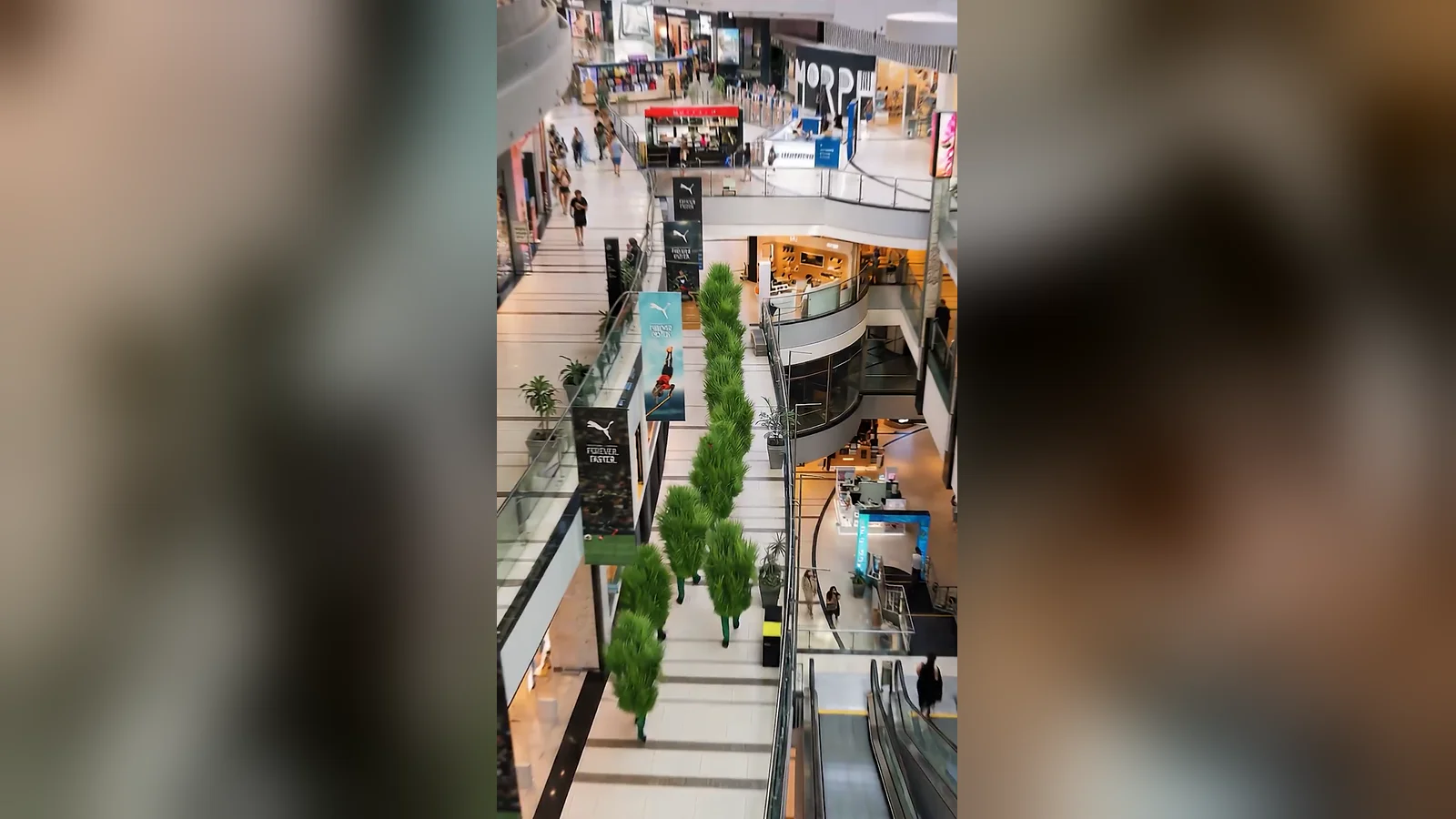
The CASC corporate video shows shopping centers as spaces for meeting, work, entertainment and brands, beyond shopping. Different regions and types are connected within a single idea of evolution and community. Art direction, AI, asset integration, editing, motion graphics and sound made it possible to build a piece with national scale without losing the human perspective.
How to tell the history of a building: the Abasto case
The renovation of the Abasto facade was going to add scaffolding and change the building's image for a while. For Abasto Shopping, the works became an opportunity to talk about history, heritage and continuity.
In the history of the Abasto, the building is the protagonist. The decades, the people and the uses change, from the old market to today's shopping center, and the place remains a meeting point. Historical reconstruction with AI, together with art direction, compositing, editing and sound design, made it possible to connect different eras in a contemporary story. In this way, the works become part of a story of caring for the building.
How to show a place that is still under construction: OH! Buenos Aires
When the piece for OH! Buenos Aires was produced, the shopping center was under construction, with no finished stores and nothing to film. The audience was not the visitor either: it was the brands and public bodies that had to picture the place up and running before committing.
The piece started from architectural renders, plans and real construction footage, and used AI video production to resolve everything a render does not provide: finished spaces, light, movement, atmosphere and people. The result was a finished piece about a place that could not yet be photographed. This kind of project has its own article: video for a project under construction.
Where a corporate video is used and how it is adapted
A corporate video almost never lives in a single place. It is projected at the opening of a conference, shown in a meeting, published on the website and cut into pieces for social media. Each use calls for a version.
For industry conferences and events, the piece usually sits alongside an invitation and content for the event's screens. This is developed in video for conferences, and a recent example is MARCCA 2026, Acecolombia's conference in Barranquilla. If the piece will be seen on large-format LED screens, it is worth reading the guide to content for LED screens. For shopping center corporate videos, the context is in video for shopping centers. And if you are an agency with an institutional client, production can be added to your team, as explained in production for agencies.
This type of piece is part of the corporate and B2B videos service.
Frequently asked questions
Can a corporate video be made without filming?
Yes. A corporate video can be built with existing material, such as photos, archive footage, renders or plans, plus AI video production for what cannot be filmed. The OH! Buenos Aires piece was made from architectural renders and real construction footage, without a single shot filmed on site. What matters is that what is shown corresponds to something real about the institution.
What material does the company need for a corporate video?
Whatever tells who it is: history, facts, documents, photos, archive footage, logos, brand guidelines and, if there is a project in development, renders and plans. Someone from the institution who knows the story and approves each stage is also needed. With that material, the production company writes the script and defines what is filmed, what is generated with AI and what is resolved in post-production.
How long is a corporate video?
The length is set by its use. A piece for the opening of a conference or a presentation can be longer than one for social media, which needs short cuts. It is worth defining in the brief where the corporate video will be shown, because the length of the main piece and the short versions that have to be planned from the script depend on it.
Can a corporate video be adapted for a conference or an invitation?
Yes, and it is worth planning for it from the start. A corporate video can be cut into versions for the opening of a conference, for the event's screens and for social media, and combined with an invitation piece. The Argentine Chamber of Shopping Centers, for example, has a corporate video and an audiovisual invitation for its FASE 2026 event.
The corporate videos for CASC, Abasto and OH! Buenos Aires are in corporate projects.